Saturday, August 28, 2010

The Walters Prize

This week we will be visiting the Auckland Art Gallery to view, research and write about the artists selected for the Walters Prize 2010. Discuss the work in the gallery with your tutors and other students and answer the following questions.

1. What is the background to the Walters Prize?

The Walters Prize is a biennial award for New Zealand artists who have made an outstanding contribution to the visual arts in the previous two years. Honouring the life and artistic legacy of Gordon Walters (1919 – 1995), the award was founded by the Auckland Art Gallery in 2002. The prize includes NZ$50,000 and an all expense paid trip to New York to exhibit at Saatchi & Saatchi’s world headquarters.


2. List the 4 selected artists for 2010 and briefly describe their work.

Saskia Leek

Yellow is the putty of the world 2009
Her paintings that respond directly to the look and the mood of sun-faded prints and Paint By Numbers pastels, and is treated in the exhibition Yellow is the Putty of the World more clearly as a subject in itself. Saskia painting has long honoured the appeals of popular images.

Fiona Connor

Something Transparent (please go round the back) 2009, mixed media
Fiona Connor’s intriguing sculptural proposition Something Transparent makes the most of the unsettling potential of the double-take. Positioning multiple reproductions of the glass façade and public entrance to the gallery in situ one behind the next, Connor’s work is both visually captivating and compelling conceptually.

Dan Arps

Explaining things 2008, mixed media
He has made careful formal gestures with materials as banal as breakfast cereal and sheets of newspaper - things a long way from the everyday idea of art. At the same time, he has made gestural paintings and elaborate objects.

Alex Monteith

Passing Manoeuvre with two motorcycles and 584 vehicles for two-channel video installation 2008
Alex Monteith has taken advantage of contemporary technology to update the kinds of image-making experiments undertaken by structuralist filmmakers in the 1960s, deriving a formal composition from the action of vehicles.

3. Who are the jury members for 2010?

Joy Bywater, Rhana Devenport, Leonhard Emmerling and Kate Montgomery.


4. Who is the judge for 2010 and what is his position in the art world?

The former-director of London's Tate Modern, Vicente Todoli will judge the Walters Prize 2010 and announce the award winner on 8 October.Todolí was artistic director for The Valencia Institute for Modern Art (IVAM), Spain, and before it opened he was their Chief curator. Throughout his distinguished career he organised and curated internationally renowned exhibitions of work by contemporary artists, making him the perfect choice to be this years judge.


5. Who would you nominate for this years Walter's Prize, and why? Substantiate
you answer by outlining the strengths of the artists work. How does this relate
to your interests in art? What aspect of their work is successful in your opinion,
in terms of ideas, materials and/or installation of the work?


http://nzcontemporary.com/contemporary-art-prizes/the-walters-prize/

Monday, August 16, 2010

Hussein Chalayan is an artist and designer, working in film, dress and installation art. Research Chalayan’s work, and then consider these questions in some thoughtful reflective writing.


1. Chalayan’s works in clothing, like Afterwords (2000) andBurka (1996) , are often challenging to both the viewer and the wearer. What are your personal responses to these works? Are Afterwords and Burka fashion, or are they art? What is the difference?

Not all clothing is fashion, so what makes fashion fashion?

I think what makes fashion fashion, is when you get someone such as celebrities/models who has a strong influence on others, put them in a piece of clothing made by recognized designers, and pop the image of them wearing those clothes out in the media. that would probably be considered as fashion.


Hussein Chalayan, Burka, 1996


Hussein Chalayan, Afterwords, 2000

2. Chalayan has strong links to industry. Pieces like TheLevel Tunnel (2006) and Repose (2006) are made in collaboration with, and paid for by, commercial business; in these cases, a vodka company and a crystal manufacturer. How does this impact on the nature of Chalayan’s work? Does the meaning of art change when it is used to sell products? Is it still art?

I don't think the meaning of art changes. It is still Hussein Chalayan’s work. Just because it is paid for by a commercial company doesn’t make it less of an art piece. I don’t think art changes when selling products.

3. Chalayan’s film Absent Presence screened at the 2005 Venice Biennale. It features the process of caring for worn clothes, and retrieving and analysing the traces of the wearer, in the form of DNA. This work has been influenced by many different art movements; can you think of some, and in what ways they might have inspired Chalayan’s approach?


Hussein Chalayan, still from Absent Presence, 2005 (motion picture)


4. Many of Chalayan’s pieces are physically designed and constructed by someone else; for example, sculptor Lone Sigurdsson made some works from Chalayan’s Echoform(1999) and Before Minus Now (2000) fashion ranges. In fashion design this is standard practice, but in art it remains unexpected. Work by artists such as Jackson Pollock hold their value in the fact that he personally made the painting. Contrastingly, Andy Warhol’s pop art was largely produced in a New York collective called The Factory, and many of his silk-screened works were produced by assistants. Contemporarily, Damien Hirst doesn’t personally build his vitrines or preserve the sharks himself. So when and why is it important that the artist personally made the piece?

I think sometimes artist ideas can be to big of a project to handle on their own,sometimes they need someones help who has the right experience to assist them in their project, so the artist plan can be properly executed. however i think most of the work has to be done by the artist themselves because it is their work.


Monday, July 26, 2010

Nathalie Djurberg

1. What do you understand by the word 'claymation'?

An animation process using clay or Plasticine figures that are moved and filmed using stop-motion photography to create a lifelike look.

2. What is meant by the term 'surrealistic Garden of Eden'? and 'all that is natural goes awry'?’

My interpretation to the term surrealistic Garden of Eden is a reverse description of the Garden of Eden. It’s made to look disoriented, hallucinatory and has a quality of a dream and all that is natural and normal goes wrong.

3. What are the 'complexity of emotions' that Djurberg confronts us with?

Djurberg was trying confront us with is the feeling of fear of the unknown and the not understood.

4. How does Djurberg play with the ideas of children's stories, and innocence in some of her work

Djurberg plays with the idea of children stories and creates such composite emotions using the characters of stories. She makes the innocent not so innocent.

There is a current fascination by some designers with turning the innocent and sweet into something disturbing. Why do you think this has come about?

I think media has a lot to do with the corruption of innocents. They twist awful thing and make them look good, they attack us with so much crap, that people tend to think that unpleasant thing are regular and gain dirty habitats at a very young age, innocents could become a thing of the past.

In your opinion, why do you think Djurberg's work is so interesting that it was chosen for the Venice Biennale?

I think this must take a lot of time and a lot of hours and a lot of patience’s to make such a complicated film and get everything perfect. Overall love the creativity that went into making it, it all looks very extraordinary.


Monday, June 7, 2010

Last blog question for semester one- Banksy's work

Banksy is a pseudonymous British graffiti artist. He is believed to be a native of Yate, South Gloucestershire, near Bristol and to have been born in 1974, but his identity is unknown. According to Tristan Manco,[who?] Banksy "was born in 1974 and raised in Bristol, England. The son of a photocopier technician, he trained as a butcher but became involved in graffiti during the great Bristol aerosol boom of the late 1980s." His artworks are often satirical pieces of art on topics such as politics, culture, and ethics. His street art, which combines graffiti writing with a distinctive stencilling technique, is similar to Blek le Rat, who began to work with stencils in 1981 in Paris and members of the anarcho-punk band Crass who maintained a graffiti stencil campaign on the London Tube System in the late 1970s and early 1980s. His art has appeared in cities around the world. Banksy's work was born out of the Bristol underground scene which involved collaborations between artists and musicians.

Banksy does not sell photos of street graffiti. Art auctioneers have been known to attempt to sell his street art on location and leave the problem of its removal in the hands of the winning bidder.

Banksy's first film, Exit Through the Gift Shop, billed as "the world's first street art disaster movie", made its debut at the 2010 Sundance Film Festival. The film was released in the UK on March5.

Banksy is legendary. In the UK, he’s pretty much a household name. Yet, mysteriously, very few people know who he really is. Those who do have done well through the years in keeping his name secret from the real public.

Much of Banksy’s work is humorous, and others have been known for subverting the media and popular icons. He’s had pieces of the Mona Lisa with a rocket launcher, crafted his own fake copies of Paris Hilton’s debut album, and made one of the UK’s most famous graffiti pieces — the one of two policemen kissing. Many of his projects have no doubt walked the line between the legal and the illegal, and some have clearly been illegal. Yet, no one has truly known who he was, and he has been safe from much scrutiny because of it.

But today the Daily Mail published an article that reveals who Banksy really is — or so they claim. It shows pictures of his work and house ‘he’ grew up in, reveals ‘his’ full name, and practically tells ‘his’ life story before he became Banksy. The article closes with a quote that Banksy by Banksy himself, saying to Swindle Magazine, “I have no interest in ever coming out. I figure there are enough self-opinionated a**holes trying to get their ugly little faces in front of you as it is.”

So why would the Daily Mail decide to share all this information and more (given that it is true)? It seems rather disrespectful.

If they aren’t correct, what about poor Robin Gunningham? Harassment incoming? People seem to be citing obituaries that detail a couple of deceased Robin Gunninghams… but that’s hardly worth anything, because who knows how many there are?

http://www.google.co.nz/imgres?imgurl=http://artandmusic.files.wordpress.com/2008/07/071208-

http://en.wikipedia.org/

'Memorial Project Nha Trang, Vietnam'(2001)

Cyclo drivers, were conceded low in society, They have now become a simple artifact of the past. However, undeveloped areas in China still use the cyclo to this day, However they are now slowly vanishing in big city’s today. Cyclo was important for transportation in the past decades in China, this cheap means of transport has provided a source of income for many of those unemployed as a result of the country’s reunification in Vietnam. While in china, it is due to the disparate development. The focus on the realities about bottom people and the past is connected with the humanism and individualism, where human thinking and actions were considered the most important. In the work, the drivers finally escaped and run into the mosquito net, which is the symbol of the unknown future, thus the author explored the risk and survival of human in modern society with the rapid development and extensions. Besides, I prefer the work itself is more connected to the idea of sublime, because of the impressive underwater scenes.

The languid motion and tough development of the rickshaw-like device at the bottom of the sea is such a gripping symbol for an entire nation discovering its identity after a half-century of political turmoil. With direct reference to the impact of the Vietnam War on his country, Nguyen-Hatsushiba's beautiful camerawork deconstructs the fate of those who are caught between old and new modes of existence. As the divers strain to hold their breath long enough to propel their vehicles a few feet farther, additional tension is created between graceful movement and precarious mortality.

Zene Holloway’s breathtaking underwater photographs. unlike the pure beauty of those photos, Nguyen-Hatsushiba's underwater project is much more thought-provoking, making us think about the past, the current and the future of human and country, where the author’s intentions is well realized.

http://www.iberkshires.com/story.php?story_id=14312

Tuesday, April 27, 2010

Landscape and the Sublime

What is the Enlightenment?

The Enlightenment was the creation of a new framework of ideas about man, society and nature dominated by Christianity.

Define the concept of the Sublime?

Its Impressive, physically created from God, it takes your breath away there is a majestic look about it.

How did the concept of the sublime come out of the Enlightenment thought?

The enlightenment was a time for new ideas about man, society ect I think that because Christianity dominated that era that everything had to be shown in a god like way.

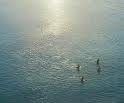
Discuss the subject matter, and aesthetic (look) of Misrach’s work to identify the sublime in his work. Add some more images.I think the way the light just rest on the water gives the image a majestic look, a peaceful relaxing look. The light is a very vital part in this image.

Identify some other artists or designers that work with ideas around the Sublime, from the Enlightenment era as well as contemporary artists.

· Joseph Wright

· Caspar Caspar David Friedrich


How does Misrach's photography make you feel? Does it appeal to your imagination?

At first I thought it was ducks flying on water but when I had a closer look it was people surfing it sort of a double look type of image. It makes me feel at peace, it has a warm since to it, I think the light is a very important part of any sublime images it give them a spiritual visits, like this image for example the light makes this picture look sublime with out the light it would look less attractive.

See full size image

See full size image

Damien Hirst (For the love http://blog.art21.org/wp-content/uploads/2009/04/fortheloveofgod.jpgof God)

Damien Hirst was born in 1965 in Bristol, UK. He lives and works in London and Devon. For the past two decades he has been widely acknowledged as the most

important and influential artist of his generation. 


For the Love of God' is a platinum cast of a human skull encrusted with 8,601 flawless diamonds. Set on the forehead is a large, pear-shaped light fancy pink diamond, called the Skull Star Diamond. The teeth are from the original skull. It was hailed worldwide and generated enormous publicity when first unveiled in 2007 at London’s White Cube. Dutch art historian Rudi Fuchs described it as “a supernatural skull, almost heavenly”. He relates Hirst’s work to the memento mori and vanitas motifs popular in the Dutch Golden Age. For the Love of God and Hirst’s personal selection of works from the Rijksmuseum collection reveal how fear of death has provided a theme in art over the centuries. Appropriately, For the Love of God appears in the Philips Wing, surrounded by the Masterpieces of the Golden Age.

Damien Hirst: “As an artist I try to make things that people can believe in, that they can relate to, that they can experience. You therefore have to show them as well as possible.”The human skull used as the base for the work, bought in a shop in lslington, is thought to be that of a European living between 1720 and 1810. The work's title was supposedly inspired by Hirst's mother, who once asked, “For the love of God, what are you going to do next?”

Hirst stated the idea for the work came from a Aztec turquoise skull at the British Museum.

Hirst said that the work was sold on 30 August 2007, for £50 million, to an anonymous consortium. Christina Ruiz, editor of The Art News paper, claims that Hirst had failed to find a buyer and had been trying to offload the skull for £38 million. Immediately after these allegations were made, Hirst claimed he had sold it for the full asking price, in cash, leaving no paper trail.

Reference:

Wikipedia, the free encyclopedia

www.fortheloveofgod.nl


Hirst defiantly showed he has money by using expensive diamonds in this piece of work, which states he is a very wealthy man. Diamonds are very expensive because they are a timeless stone witch is hard to come around. People attactchment to diamonds become very strong thinking diamond are everything they start to become emotionally attached to these small objects and would do any thing to get their hands on it by trade or killing people to get a hold of a expensive timeless stone. Hirst artwork is a timeless piece, which will show that he is a wealthy man for centuries to come.